

news
How to Ride Deep Ruts in Motocross: Body Position & Throttle Control Guide
To ride deep ruts in motocross without cross-rutting or falling, enter standing up on the balls of your feet, brake before the rut begins, and look at the exit rather than your front fender. Sit down smoothly right at the apex with your head over the handlebars, weight the outside footpeg with 70 percent of your body pressure, tuck your inside boot high alongside the radiator shroud, and carry a taller gear (third gear instead of second) while feathering the clutch smoothly.
Nothing strikes fear into an intermediate motocross rider quite like arriving at a tight bowl turn scarred by three-foot-deep, curving dirt trenches. One twitch of panic on the front brake lever catches the sidewall, violently throwing the bike sideways into a painful high-side ejection. Yet for elite factory professionals, deep ruts are not obstacles: they are slot-car tracks that offer infinite traction when approached with proper biomechanics and throttle discipline.

Weighting the outside footpeg while keeping the inside boot tucked high allows the bike to lean without catching frame rails
Rule 1: Vision Tracking and Corner Entry Deceleration
The golden rule of rut riding is that the motorcycle follows your eyes. When riders stare at the entrance of the rut or look down at their front tire, their body freezes, locking the steering head and causing the front tire to climb out of the groove. You must scan the entire corner, pick your rut slot three bike lengths before arrival, and lock your gaze onto the corner exit before you even sit down.
Equally critical is completing all braking before entering the rut. Grabbing front brake inside a deep rut loads the front suspension fork violently, compressing the rake angle and causing the front tire to tuck into the soft dirt wall. Enter with smooth rolling momentum, off the brakes, so the chassis remains balanced on its springs.
| Phase | Body Position | Controls & Throttle | Fatal Mistake to Avoid |
|---|---|---|---|
| Phase 1: Entry | Standing on balls of feet, central balance | Hard braking completed in straight line | Braking inside the rut channel |
| Phase 2: Transition | Sit smoothly forward at front of seat | One finger covering clutch; zero brakes | Slumping backward onto rear fender |
| Phase 3: Apex | Weight outside peg; tuck inside boot high | Smooth throttle roll; feather clutch slip | Dragging inside foot on dirt berm |
| Phase 4: Exit | Stand up over rear pegs as bike straightens | Full throttle acceleration in tall gear | Chopping throttle mid-rut causing stall |
Rule 2: The Outside Footpeg Weighting Secret
The physical anchor that prevents a dirt bike from sliding down or climbing out of a rut is outside footpeg pressure. When you lean a motorcycle into a 45-degree angle inside a trench, centrifugal force attempts to push the chassis outward. By driving your outside heel down through the peg with 70 percent of your lower-body weight, you force the side knobs of both front and rear tires to bite directly into the rut’s wall.
Simultaneously, your outside knee must firmly clamp against the radiator shroud and fuel tank. This skeletal lock links your upper body mass directly to the chassis center of gravity. If your outside leg remains loose, the motorcycle will wander unpredictably beneath you, catching footpegs against the dirt edges.
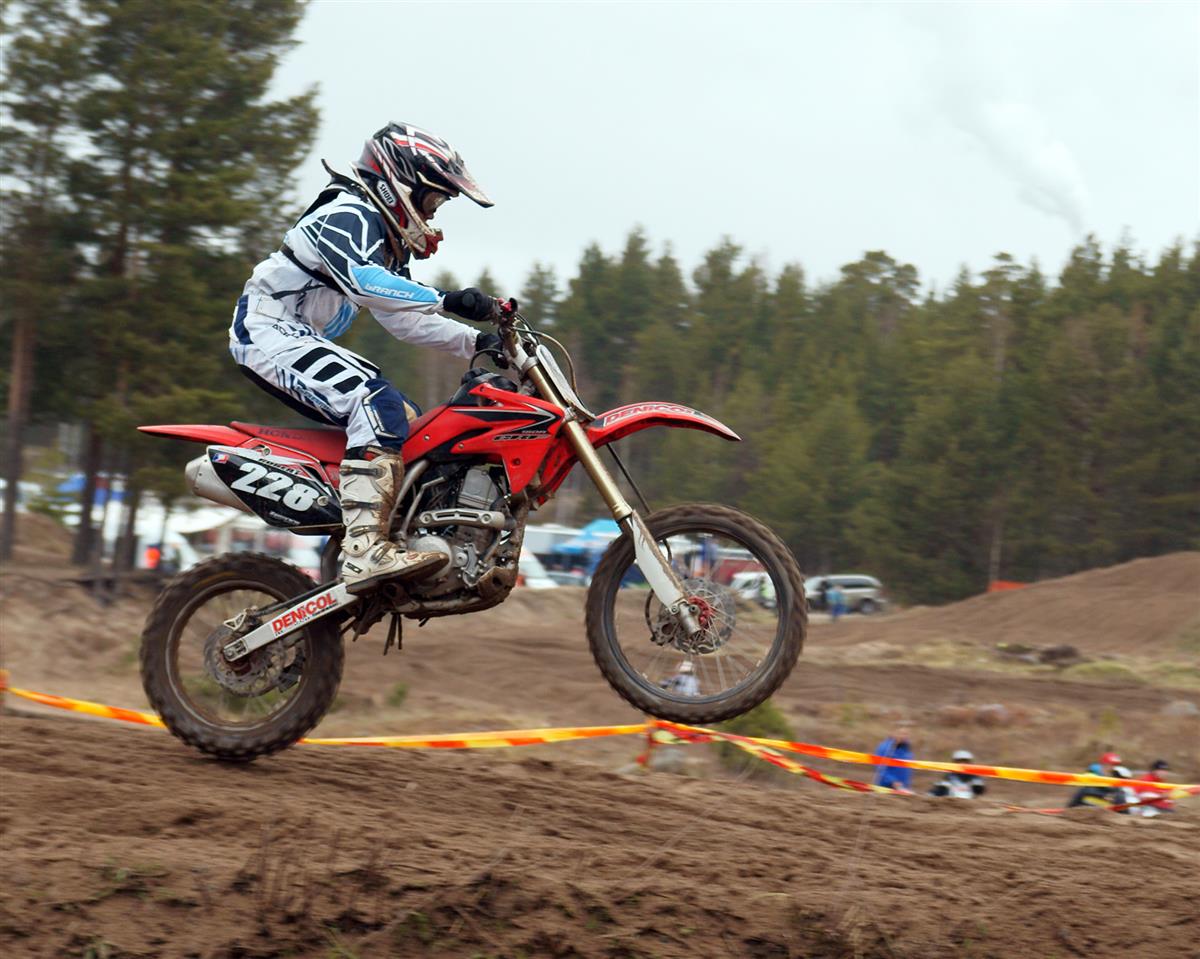
Tucking the inside boot close to the front axle keeps weight balanced without dragging in deep dirt
Rule 3: Gearing Up and Clutch Feathering
The most common mechanical error in deep ruts is riding in too low of a gear. When an aggressive rider clicks down into second gear on a 450 machine, the engine delivers abrupt, jerky throttle response. Any slight twitch of the wrist spins the rear wheel, breaking traction and causing the rear end to climb out of the rut.
The professional technique involves riding one gear taller (third gear) and using the clutch lever to regulate engine torque. A taller gear produces smooth, broad power pulses that allow the rear tire to hook up against the rut wall. As analyzed in our review of European Grand Prix rut mastery, carrying momentum in high gears eliminates erratic chassis pitching.
Accelerating out of the rut requires progressive throttle application and steady peg pressure
Video Tutorial: The Secret to Hitting Ruts
Mastering Rut Confidence for Race Day
Riding deep ruts is fundamentally a psychological victory over instinct. Your survival instincts tell you to look down, slow down, and put your foot out to catch yourself. Overcoming that reflex through disciplined vision tracking, heavy outside peg weighting, and tall gear rolling transforms the most daunting section of the racetrack into your greatest competitive advantage.
Authoritative training organizations including the AMA and coaches featured on Racer X Illustrated agree that practicing ruts on private test days is the fastest way to drop three seconds off your lap times. Commit to the slot, trust your outside peg, and rail the turn with total conviction.
FAQs
What should I do if my front wheel starts climbing out of the rut?
Never grab the front brake. Instead, increase outside footpeg pressure, look further ahead toward the corner exit, and maintain smooth, steady throttle. Chopping the throttle causes the front fork to compress, making the bike climb out even faster.
Is it better to sit or stand through deep ruts?
In tight, curved ruts, sitting forward at the apex with your inside leg pointed toward the front hub offers optimal turn radius. However, in long, straight rolling ruts, standing on the footpegs allows the chassis to float without bottoming frame rails.
How do I stop my footpeg from catching on the rut wall?
Lean the motorcycle with the rut angle rather than fighting it upright. Keep your outside knee clamped tight to the fuel tank, ensuring the bike maintains an exact parallel trajectory with the curved dirt wall.
Take trackside grit into everyday streetwear with premium graphic tees and hoodies from KozmozRacing Outfits.
`;
// —————————————————-
// POST 10: Haiden Deegan 450 Move: Is “Danger Boy” Ready for Supercross 450cc?
// ———————————————–